
WPC wall panels have become a popular choice for homeowners, architects and designers looking for a modern alternative to traditional timber wall finishes. From decorative living room feature walls to exterior building façades, these panels offer a timber-inspired appearance with the practical benefits of composite materials.
But what exactly are WPC wall panels, and how do they differ from traditional timber, PVC panels or other wall cladding materials?
WPC stands for Wood Plastic Composite, a manufactured material that combines wood-based fibres or flour with plastic polymers and additives. Depending on their construction, WPC panels can be used for interior decoration or as part of an exterior wall cladding system.
However, not every WPC panel is suitable for every environment. Interior decorative panels and exterior WPC cladding have different performance requirements, installation methods and applications.
In this complete guide, we’ll explore what WPC wall panels are, how they’re manufactured, their advantages and limitations, the differences between indoor and outdoor products, and what Australian homeowners should consider before choosing them.
What are WPC Wall Panels? Quick Answer
WPC wall panels are wall-covering products manufactured from Wood Plastic Composite, a material made by combining wood-based components with thermoplastic polymers.
They are available in decorative profiles, including flat, slatted and fluted designs, and are commonly used to create timber-look wall finishes.
WPC wall panels can be used indoors or outdoors, but only when the specific product is designed for that application. Interior panels are generally intended for decorative purposes, while exterior WPC cladding must withstand weather exposure and meet applicable building requirements.
For example, TrueBuild offers WPC Outdoor Wall Cladding in three lengths—2000 mm, 2900 mm and 3600 mm—with a nominal width of 220 mm and thickness of 26 mm.
What does WPC Stand For?
WPC stands for Wood Plastic Composite.
It refers to a category of materials that combine wood-based components with plastic polymers to create a manufactured composite.
Unlike natural timber, which is cut and processed from solid wood, WPC is manufactured by combining different ingredients into a finished material.
The wood component may include wood fibres, wood flour or similar materials, while the polymer component may include polyethylene, polypropylene or PVC, depending on the manufacturer.
Additional ingredients can include colour pigments, UV stabilisers and other additives that influence appearance, processing and performance.
Because manufacturers use different formulations, two products described as WPC may have different characteristics.
This is why it’s important to check the specifications of the actual product rather than assuming all WPC panels offer identical durability, moisture resistance or installation requirements.
What are WPC Wall Panels Made Of?
Most WPC wall panels contain three main groups of materials.
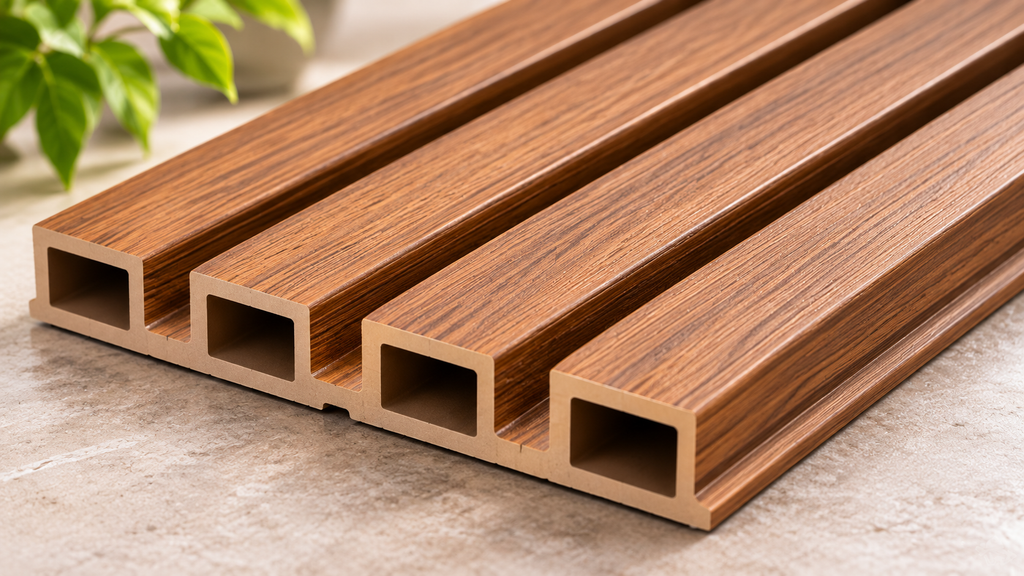
Wood-Based Components
Wood fibres or wood flour form part of the composite structure.
These materials contribute to the composite’s physical properties and can help produce a timber-inspired appearance.
The type and proportion of wood-based material vary between manufacturers.
Plastic Polymers
Thermoplastic polymers bind the composite together and influence its strength, moisture behaviour and manufacturing characteristics.
The choice of polymer can affect how the finished panel responds to temperature changes and environmental exposure.
Additives and Surface Finishes
Manufacturers may include pigments, stabilisers and processing additives to achieve particular colours or performance characteristics.
Some WPC panels also have additional surface finishes or protective layers.
These can influence colour consistency, UV resistance and maintenance requirements.
The finished panel’s properties depend on its complete formulation and construction, not simply the presence of wood and plastic.
How are WPC Wall Panels Manufactured?
Many WPC wall panels are manufactured using an extrusion process.
During manufacturing, wood-based materials, plastic polymers and additives are blended before being heated and formed through a specially shaped die.
The material is then cooled and cut into the required lengths.
This process allows manufacturers to produce consistent decorative profiles, including flat panels, hollow sections and fluted wall cladding.
Some products receive additional surface finishing to create timber-look colours and textures.
The manufacturing process also allows panels to be produced in different widths, thicknesses and lengths.
For homeowners, this means WPC products are available in a wide variety of designs, making them suitable for different architectural styles.
However, the performance of the finished panel still depends on the quality of the materials, manufacturing process and intended application.
What are the Main Benefits of WPC Wall Panels?
WPC wall panels offer several potential advantages over conventional decorative wall finishes.
The exact benefits depend on the product formulation, installation method and environment.
1. Natural Timber-Look Appearance
One of the main reasons people choose WPC wall panels is their decorative appearance.
Many products are designed to resemble natural timber, offering warm colours and textured finishes without requiring solid timber boards.
Fluted and slatted WPC panels are particularly popular in contemporary interiors because they create depth and visual interest.
For exterior applications, timber-look WPC cladding can complement modern architectural designs, particularly when combined with glass, concrete, stone or metal.
2. Low Maintenance Requirements
Many WPC wall panels are designed to require less routine maintenance than certain natural timber finishes.
Depending on the product, they may not require regular sanding, staining or repainting.
Routine cleaning is often sufficient to maintain their appearance.
This can be particularly useful for exterior feature walls and commercial spaces where frequent maintenance may be inconvenient.
However, maintenance requirements still depend on the panel’s surface finish and exposure conditions.
3. Moisture Resistance
WPC materials can offer improved resistance to certain moisture-related issues compared with untreated timber.
The plastic component influences how the composite interacts with moisture.
However, WPC products vary in water absorption and long-term moisture performance.
Interior decorative panels should not automatically be considered suitable for bathrooms, shower enclosures or outdoor environments.
Exterior-rated products are designed for more demanding conditions, but the complete wall system still needs appropriate weatherproofing and drainage.
4. Resistance to Termites and Rot
Some WPC formulations are designed to resist deterioration associated with termites, fungal decay and rot.
TrueBuild’s WPC Outdoor Wall Cladding is marketed as resistant to termites and rot.
This can be an attractive feature for outdoor applications where untreated timber may require additional protection.
Nevertheless, the degree of resistance depends on the product’s formulation and supporting test evidence.
5. Wide Range of Colours and Designs
WPC panels are available in multiple colours, profiles and surface textures.
Homeowners can choose finishes that complement existing furniture, flooring, landscaping or architectural materials.
For example, TrueBuild’s exterior WPC cladding is available in Black, White, Brown, Charcoal Grey and Redwood.
Darker colours can create a contemporary appearance, while warmer timber-inspired finishes can complement natural landscaping and traditional materials.
6. Consistent Manufactured Profiles
Unlike natural timber, which can vary in grain and appearance between individual boards, manufactured WPC panels can provide more consistent profiles.
This can help create uniform decorative patterns across larger wall surfaces.
Consistent dimensions may also make installation planning more straightforward when the correct joining and fixing systems are used.
What are the Different Types of WPC Wall Panels?
WPC wall panels can be divided into several categories based on their intended application and design.
Interior Decorative WPC Wall Panels
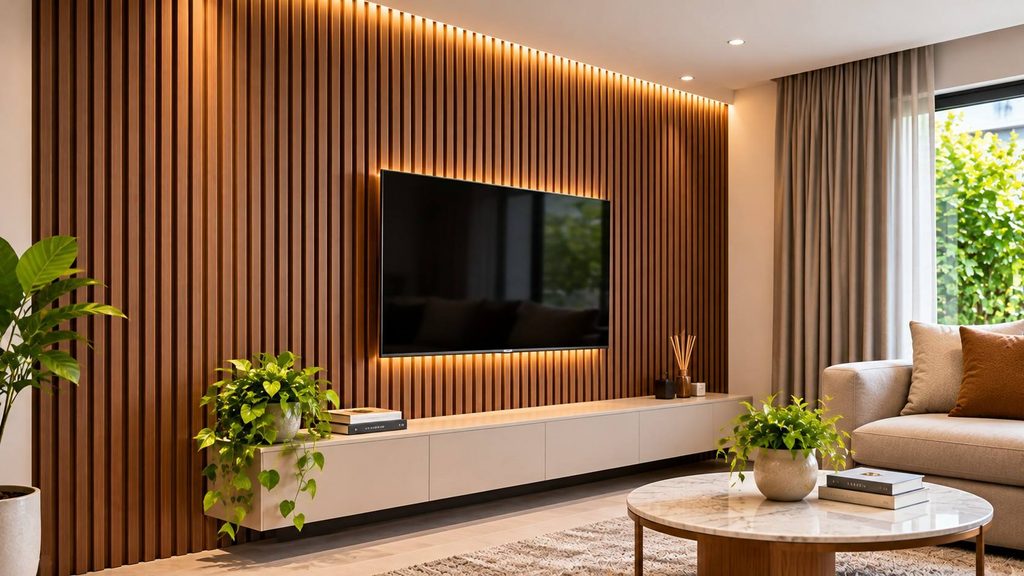
Interior WPC panels are primarily used to improve the appearance of internal walls.
They are commonly available in fluted, slatted and flat decorative profiles.
These panels can be used behind televisions, beds, reception desks and other feature areas.
Interior decorative products may use adhesive, clips or mechanical fixings, depending on their construction.
However, they should not automatically be installed outdoors or in wet areas.
Their suitability depends on the manufacturer’s product specifications.
Exterior WPC Wall Cladding
Exterior WPC cladding is specifically designed for outdoor wall applications.
These products must withstand environmental conditions such as sunlight, rainfall, humidity and temperature changes.
Exterior cladding also requires more detailed installation planning.
Depending on the system, installation may involve timber or metal battens, compatible clips, screws, finishing trims and appropriate allowances for thermal expansion.
The complete exterior wall assembly must also address weatherproofing, structural support and applicable fire-safety requirements.
Fluted WPC Wall Panels
Fluted panels feature repeated raised or recessed sections that create a three-dimensional appearance.
They are often selected for modern interiors because the vertical or horizontal lines add texture without requiring elaborate decoration.
Some exterior WPC products also use fluted profiles.
Flat WPC Wall Panels
Flat WPC panels provide a simpler surface appearance.
They may be suitable for projects where a clean, understated wall finish is preferred.
Their suitability for interior or exterior use depends on the specific product.
Truebuild WPC Outdoor Wall Cladding: Features and Specifications
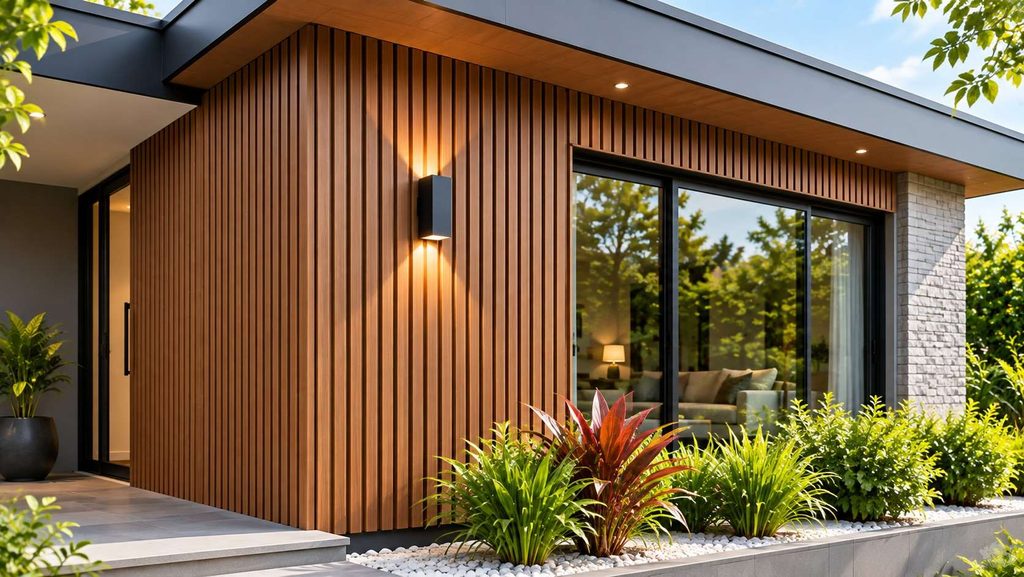
For homeowners considering WPC panels for exterior applications, choosing a product designed for outdoor exposure is essential.
Truebuild WPC Outdoor Wall Cladding is a timber-look exterior cladding product manufactured from Wood Plastic Composite.
It is intended for residential and commercial applications, including exterior walls, façades, balcony feature walls and outdoor architectural areas.
The panels are available in five colours and three lengths, allowing customers to select finishes and dimensions that suit different project requirements.
Truebuild WPC Outdoor Cladding Specifications
| Specification | Details |
|---|---|
| Product | TrueBuild WPC Outdoor Wall Cladding |
| Material | Wood Plastic Composite |
| Nominal width | 220 mm |
| Thickness | 26 mm |
| Available lengths | 2000 mm, 2900 mm, 3600 mm |
| Available sizes | 220 × 26 × 2000 mm, 220 × 26 × 2900 mm, 220 × 26 × 3600 mm |
| Colours | Black, White, Brown, Charcoal Grey, Redwood |
| Application | Exterior wall cladding |
| Supporting framework | Timber or metal battens |
| Fixing methods | Compatible WPC clips, screws or recommended fixing accessories |
| Finishing | Matching corner trims, edge trims and finishing profiles |
Available Colour Options
TrueBuild offers five exterior WPC cladding colours.
Black: A bold finish that can complement contemporary architecture and lighter surrounding materials.
White: A lighter option for projects seeking a clean, minimalist appearance.
Brown: A warm timber-inspired colour suitable for residential and commercial exteriors.
Charcoal Grey: A modern neutral finish that works well with concrete, metal and glass.
Redwood: A richer timber-look option that can complement natural landscaping and warmer architectural palettes.
The best choice depends on the surrounding materials, lighting conditions and overall design.
Weather and UV Resistance
TrueBuild’s exterior WPC cladding is designed for outdoor conditions and is described as weather- and UV-resistant.
These characteristics are important for Australian homes, where exterior materials may experience prolonged sunlight, seasonal rainfall and temperature changes.
However, long-term colour stability and weather performance depend on the product’s formulation, exposure and maintenance.
Specific performance ratings should be confirmed through manufacturer documentation.
Moisture, Termite and Rot Resistance
TrueBuild describes its outdoor WPC cladding as waterproof and resistant to termites and rot.
These are useful product characteristics for exterior applications, but they should not be confused with the waterproofing performance of an entire building wall.
Even where cladding panels resist water exposure, the underlying wall assembly still requires appropriate weatherproofing, flashing, drainage and installation detailing.
Fire Performance and Sustainability
TrueBuild lists fire-retardant properties and eco-friendly construction among its product features.
These claims should be considered alongside the manufacturer’s technical documentation.
A description such as fire-retardant does not, by itself, establish compliance with Australian building fire requirements.
Similarly, environmental performance depends on factors such as material sourcing, recycled content, manufacturing processes and product lifespan.
For regulated building applications, obtain the relevant compliance documentation before selecting the product.
Where Can You Use WPC Wall Panels?
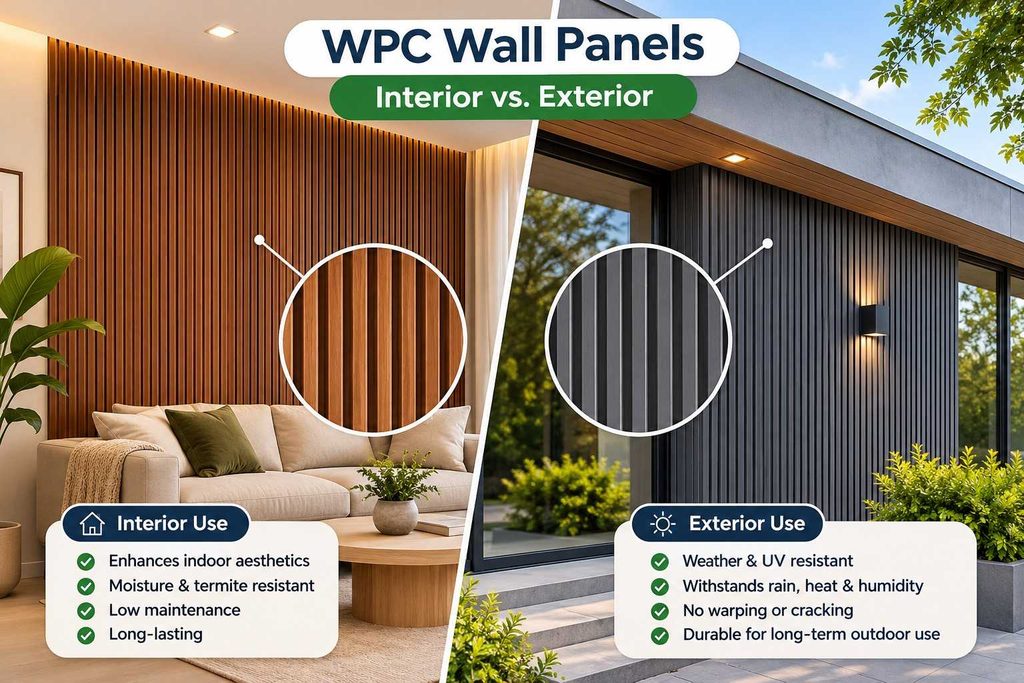
WPC panels can be used in a variety of residential and commercial spaces, provided the selected product is suitable for the intended environment.
Living Room Feature Walls
Interior decorative WPC panels can create a textured feature wall behind a television or seating area.
Timber-look finishes can add warmth to contemporary interiors, particularly when paired with neutral furniture and soft lighting.
Fluted profiles can also create visual depth without requiring additional wall decorations.
Bedrooms
WPC panels can be installed behind a bed to create a decorative backdrop.
They can complement upholstered headboards, bedside lighting and timber-look flooring.
For bedrooms, select an interior product suitable for the room’s conditions and applicable requirements.
Home Offices
Decorative WPC wall panels can provide a consistent background for home offices and video meetings.
They can also introduce texture into spaces dominated by desks, shelving and other hard surfaces.
However, WPC panels should not automatically be treated as acoustic panels unless the specific product has verified sound-absorption performance.
Hallways and Reception Areas
Commercial reception areas and residential hallways can benefit from decorative wall finishes.
WPC panels may be used to create feature sections around entrances, reception counters and circulation areas.
Exterior House Walls
Exterior-rated WPC cladding can create a timber-inspired appearance on residential façades.
For this application, the cladding must be installed using a suitable supporting framework and fixing system.
The complete wall assembly must also meet applicable building and weatherproofing requirements.
Balconies and Outdoor Entertaining Areas
TrueBuild’s exterior WPC cladding is intended for outdoor architectural applications, including suitable balcony feature walls and entertaining areas.
These spaces can benefit from timber-look finishes that complement outdoor furniture and landscaping.
Before installation, confirm that the cladding is suitable for the specific exposure conditions and building requirements.
Are WPC Wall Panels Waterproof?
WPC panels are often promoted for their moisture resistance, but the term waterproof needs careful interpretation.
The plastic component can influence moisture absorption, while the wood-based component may still affect how the material responds to prolonged exposure.
The actual performance depends on the formulation, profile design, surface finish and installation.
TrueBuild describes its outdoor WPC cladding as waterproof, reflecting its intended use in exterior environments.
However, water-resistant or waterproof cladding panels do not automatically make the entire wall waterproof.
Exterior walls still require appropriate weatherproofing components, including flashing and drainage provisions where necessary.
For interior bathrooms or other wet areas, use only products specifically approved for those conditions.
WPC Wall Panels vs PVC Wall Panels
WPC and PVC wall panels are both manufactured products, but they differ in material composition and available applications.
| Feature | WPC wall panels | PVC wall panels |
|---|---|---|
| Material | Wood-based material combined with polymers | Primarily PVC-based material |
| Appearance | Commonly available in timber-look finishes | Available in smooth, printed and textured finishes |
| Moisture behaviour | Depends on formulation and construction | Depends on panel and joint design |
| Weight | Varies by product and profile | Varies; many decorative panels are lightweight |
| Interior use | Available in decorative profiles | Available in decorative profiles |
| Exterior use | Requires exterior-rated product | Requires exterior-rated product |
| Maintenance | Generally straightforward | Generally straightforward |
Neither material is universally better.
For example, a PVC system specifically designed for wet areas may be more appropriate than an interior WPC panel that has not been approved for moisture exposure.
Likewise, an exterior-rated WPC cladding system may be suitable for a façade where a decorative interior PVC panel would not be appropriate.
The best choice depends on the product specifications, installation environment and design requirements.
WPC Wall Panels vs Traditional Timber
Natural timber remains a popular choice for wall cladding because of its authentic grain and appearance.
WPC provides an alternative for projects seeking manufactured profiles and potentially lower routine maintenance.
| Feature | WPC wall panels | Natural timber |
|---|---|---|
| Appearance | Manufactured timber-look finish | Natural grain and colour variation |
| Maintenance | Often requires less routine coating maintenance | May require periodic staining or sealing |
| Moisture response | Depends on composite formulation | Depends on species, treatment and finish |
| Profile consistency | Generally consistent manufactured dimensions | Natural variation between boards |
| Outdoor suitability | Requires exterior-rated product | Requires suitable species, treatment and detailing |
| Environmental considerations | Depends on composition, sourcing and disposal | Depends on sourcing, treatment and lifespan |
WPC isn’t automatically more durable or more sustainable than timber.
Performance depends on the specific product, exposure conditions and maintenance.
For a more detailed comparison, read WPC wall cladding vs timber cladding.
How to Install WPC Wall Panels
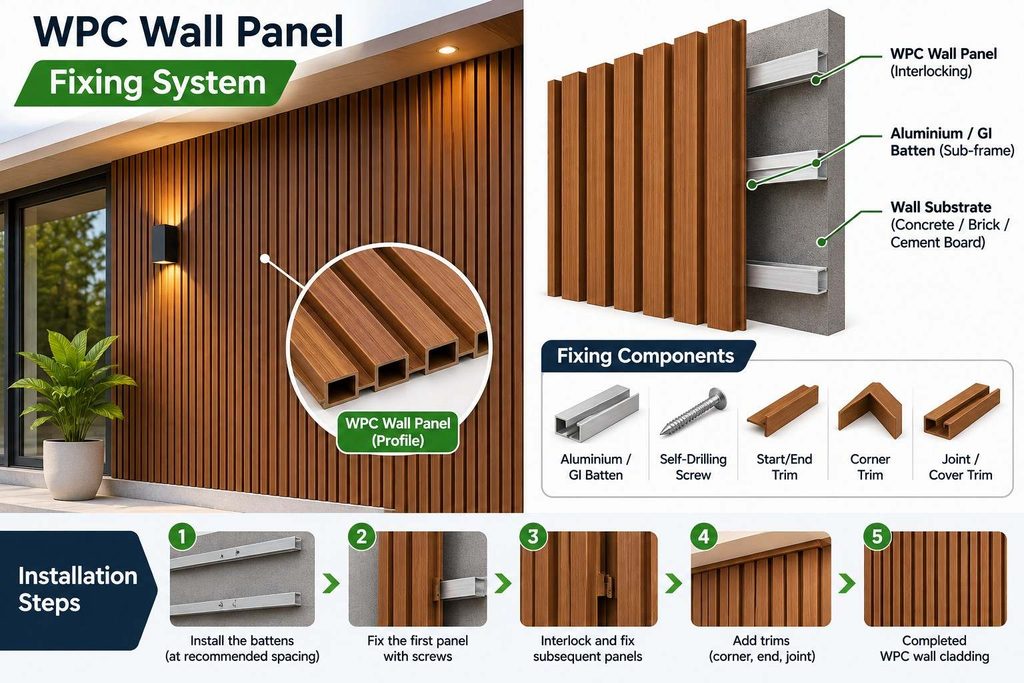
Installing WPC wall panels requires different approaches depending on whether the product is intended for interior decoration or exterior cladding.
Interior decorative panels may be installed using adhesive, clips or mechanical fixings where approved by the manufacturer.
Exterior WPC cladding generally requires a supporting framework and a compatible mechanical fixing system.
The following steps describe TrueBuild’s general outdoor cladding installation process.
Step 1: Prepare the Wall and Supporting Surface
Before installing exterior WPC cladding, inspect the wall and confirm that it is suitable for the proposed installation.
The surface or supporting framework should be clean, level and structurally secure.
Remove loose materials and identify any uneven areas that could affect the finished cladding.
Also check the underlying wall assembly for existing damage or moisture problems.
Exterior cladding is only one part of the building envelope. It should not be assumed to replace required weatherproofing membranes, flashing or other wall-system components.
Step 2: Install Timber or Metal Battens
TrueBuild’s installation guidance specifies timber or metal battens as the supporting framework.
Battens provide fixing points for the WPC panels and help create a consistent installation surface.
Position them according to the manufacturer’s recommended spacing.
Secure the battens to the underlying supporting structure using suitable fixings.
The spacing and fixing arrangement must account for the cladding system, supporting wall and installation conditions.
Do not select batten spacing arbitrarily, particularly for exposed exterior walls.
Step 3: Measure and Cut the WPC Cladding Panels
TrueBuild outdoor WPC cladding is available in three lengths:
- 2000 mm
- 2900 mm
- 3600 mm
All three options have a nominal width of 220 mm and thickness of 26 mm.
Measure the installation area carefully before selecting panel lengths.
Choosing an appropriate length can help reduce unnecessary cutting and material waste.
Mark the required dimensions and cut the panels using tools suitable for WPC materials.
Support the panels properly during cutting and follow the manufacturer’s safety instructions.
Before installation, confirm any required expansion clearances and allowances around surrounding structures.
Step 4: Secure the Panels Using Compatible WPC Fixings
Once the supporting framework is ready, begin positioning the cladding panels.
TrueBuild’s installation guidance identifies compatible WPC clips, screws and recommended fixing accessories.
Start with the first panel and check its alignment before fastening.
Secure the panel using the appropriate fixing system for its profile and supporting framework.
Avoid substituting unrelated clips or screws without confirming their suitability.
The correct fixing arrangement depends on the panel design and installation conditions.
Step 5: Maintain Consistent Spacing and Allow for Expansion
Continue installing the remaining panels, checking alignment throughout the process.
WPC materials can expand and contract as temperatures change.
This makes expansion allowances important, particularly for exterior installations exposed to direct sunlight.
Follow the manufacturer’s specified spacing requirements at panel joints, ends and surrounding structures.
Avoid forcing panels tightly together where movement clearances are required.
Consistent spacing helps maintain a neat appearance while allowing the material to respond to temperature changes.
Step 6: Install Corner Trims and Finishing Profiles
Once the panels are secured, complete the installation with suitable finishing accessories.
TrueBuild recommends matching corner trims, edge trims and finishing profiles.
These help create a clean appearance around corners, exposed edges and transitions.
Check that the finishing details do not obstruct required drainage, ventilation or movement clearances.
Finally, inspect the installation for loose panels, uneven joints and incomplete fixing points.
Can Interior WPC Panels Be Installed the Same Way?
Not necessarily.
Interior decorative WPC panels may use different installation systems depending on their design and weight.
Some are suitable for adhesive installation, while others require clips, screws or supporting battens.
Always follow the installation instructions for the specific interior product rather than applying exterior cladding methods automatically.
How Many WPC Cladding Panels Do You Need?
The number of panels required depends on the wall dimensions, panel orientation and usable coverage width.
TrueBuild outdoor WPC cladding has a nominal width of 220 mm.
However, the usable coverage width may differ if the panels have overlapping or interlocking profiles.
Example Calculation
Suppose an exterior wall measures 3000 mm wide.
Using the nominal panel width:
3000 ÷ 220 = 13.64
This suggests approximately 14 panels across the wall before allowing for usable coverage differences, cutting waste or installation details.
The actual quantity must be calculated using the manufacturer’s confirmed effective coverage width.
For accurate ordering, also consider panel lengths, wall openings, corners and potential cutting waste.
How Long Do WPC Wall Panels Last?
The lifespan of WPC wall panels depends on several factors.
These include the material formulation, manufacturing quality, installation method, maintenance and environmental exposure.
Interior decorative panels generally experience different conditions from exterior cladding.
Outdoor products must withstand sunlight, rainfall, temperature changes and other environmental factors.
TrueBuild describes its exterior WPC cladding as designed for long-term outdoor performance.
However, a specific service-life estimate should be supported by manufacturer documentation or warranty information.
When comparing products, review the available warranty terms and technical specifications rather than relying on general lifespan claims.
How to Clean and Maintain WPC Wall Panels
One of the practical advantages of many WPC products is their relatively straightforward maintenance.
However, cleaning requirements depend on the surface finish and installation environment.
Cleaning Interior WPC Panels
For interior decorative panels, remove dust using a soft cloth or suitable cleaning attachment.
Where permitted by the manufacturer, use a slightly damp cloth to remove surface marks.
Avoid abrasive cleaning products and harsh solvents.
Cleaning Exterior WPC Cladding
Exterior panels may collect dust, dirt and environmental deposits over time.
Clean the surface using methods approved by the manufacturer.
Avoid high-pressure washing or aggressive chemicals unless specifically permitted.
Inspect the cladding periodically for loose fixings, damaged panels or unusual movement.
If a problem is identified, investigate the cause rather than simply covering or concealing the affected area.
Are WPC Wall Panels Suitable for Brisbane Homes?
Brisbane’s warm climate, humidity, seasonal rainfall and sunlight exposure make material selection important for exterior wall applications.
Interior decorative WPC panels can be considered for suitable living rooms, bedrooms, offices and other internal spaces.
For outdoor applications, choose products specifically designed for exterior exposure.
TrueBuild WPC Outdoor Wall Cladding is intended for exterior use and is marketed as resistant to weather, UV exposure, moisture, termites and rot.
Its available colours—Black, White, Brown, Charcoal Grey and Redwood—provide options for different architectural styles.
However, local climate is only one consideration.
The complete installation must also account for building classification, fire requirements, structural support, wind exposure and weatherproofing.
For more information, read our guide to interior vs exterior wall cladding.
How to Choose the Right WPC Wall Panels
Choosing WPC wall panels involves more than selecting a colour or decorative profile.
Start by identifying whether the panels will be installed indoors or outdoors.
For interior applications, appearance, panel dimensions, cleaning requirements and installation compatibility may be the main considerations.
For exterior cladding, additional factors become important.
Check the Intended Application
Confirm that the product is designed for the environment where it will be installed.
Do not use interior decorative panels outdoors unless the manufacturer specifically approves that application.
Review the Panel Dimensions
Check the width, thickness, available lengths and usable coverage dimensions.
For TrueBuild outdoor WPC cladding, the nominal width is 220 mm and the thickness is 26 mm, with three available lengths.
Confirm the Fixing System
Exterior WPC cladding requires compatible fixing accessories and an appropriate supporting structure.
Before purchasing, confirm the required battens, clips, screws, trims and movement allowances.
Consider Weather Exposure
For outdoor applications, review the product’s suitability for sunlight, moisture and temperature changes.
Check any available performance documentation and warranty conditions.
Verify Building Compliance
Exterior cladding must be suitable for the intended building and meet applicable Australian requirements.
Fire performance, weatherproofing and structural considerations may affect whether a particular product can be used.
Obtain the relevant technical documentation and professional advice where required.
Final Thoughts
WPC wall panels offer a versatile alternative to conventional decorative wall finishes and selected timber cladding applications. They are available in different profiles, colours and dimensions, making them suitable for a range of residential and commercial designs.
However, choosing the correct product is essential.
Interior decorative WPC panels and exterior WPC cladding are designed for different environments and should not be treated as interchangeable. For exterior projects, TrueBuild WPC Outdoor Wall Cladding offers timber-look finishes in five colours and three panel lengths, with installation using timber or metal battens and compatible fixing accessories.
Before purchasing, review the product dimensions, installation requirements, available technical documentation and suitability for your building.
Explore TrueBuild’s website to learn more about wall panels and exterior cladding options for Brisbane homes and commercial projects.
Disclaimer: This guide provides general product and installation information. Product performance, fixing requirements and building compliance depend on the specific installation. Follow manufacturer instructions and obtain qualified professional advice where necessary.