
Choosing between composite decking and timber is one of the biggest decisions when planning an outdoor deck.
Timber has been used for Australian decks for decades and remains popular for its natural appearance, warmth and character. Composite decking offers a more consistent appearance and is generally chosen for lower ongoing maintenance and resistance to common outdoor conditions.
So which is better?
There isn’t one answer for every Australian home. The better option depends on your budget, climate, exposure to sunlight and moisture, preferred appearance and how much maintenance you are prepared to do.
This guide compares composite decking and timber across the factors that matter most so you can choose the right option for your project.
What is the Difference Between Composite and Timber Decking?
The biggest difference is the material itself.
Timber decking is made from natural wood. Common Australian options include hardwoods such as Merbau, Blackbutt, Spotted Gum and Ironbark, as well as treated pine. Different timber species have different levels of durability, appearance and maintenance requirements.
Composite decking is a manufactured material generally made using a combination of wood-based fibres and polymer materials. The exact formulation and construction vary between products.
Because timber is a natural material, every board can have differences in grain, colour and texture. Composite decking is manufactured for a more consistent appearance.
The materials also respond differently to outdoor conditions. Timber naturally weathers and requires ongoing care, while composite decking is generally designed to reduce maintenance and maintain a more consistent appearance over time. If you want to understand composite decking in more detail, read our guide to what composite decking is and how it works.
Composite Decking vs Timber: Which is Better Overall?
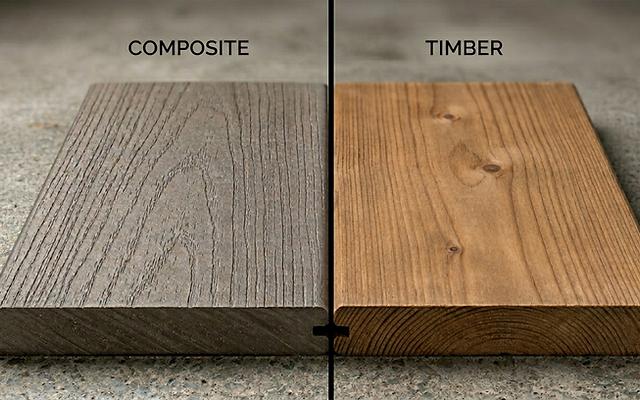
For homeowners who prioritise low maintenance and a consistent modern appearance, composite decking is often the more convenient choice.
For homeowners who prioritise natural timber character, traditional appearance and a cooler feel under direct sunlight, timber may be more suitable.
The decision becomes clearer when you compare the materials across individual factors.
Which Requires Less Maintenance: Composite or Timber?
Composite decking generally requires less ongoing maintenance than timber.
Timber decking can require regular cleaning and protective treatments such as oiling, staining or sealing depending on the timber species, finish and desired appearance.
Exposure to sunlight and moisture can gradually change the colour and surface of timber. Keeping a timber deck looking its best therefore requires ongoing attention.
Composite decking generally needs routine cleaning rather than regular surface coating. Sweeping away debris and washing the surface periodically can help keep it clean.
This doesn’t mean composite decking is completely maintenance-free. It still needs appropriate cleaning and care, and the manufacturer’s maintenance instructions should be followed.
Best for low maintenance: Composite decking
Which Lasts Longer: Composite Decking or Timber?
This depends on the specific products and how they are installed and maintained.
High-quality timber can be very durable, particularly when an appropriate species is selected for the environment and the deck is properly maintained.
Composite decking is manufactured to resist many of the problems that can affect natural timber, including moisture-related deterioration, splintering and some forms of weathering.
However, you shouldn’t compare lifespan using generic numbers alone.
A decking product’s expected service life can depend on:
- Material quality
- Board construction
- UV exposure
- Moisture
- Installation
- Maintenance
- Foot traffic
- Local environmental conditions
When comparing products, look at the manufacturer’s warranty and technical documentation rather than assuming every composite board or timber species has the same lifespan.
Best for lower maintenance over time: Composite decking
Best for natural long-term durability: Depends on the timber species and maintenance
The expected lifespan of decking also depends on the product, installation and maintenance.
Which Looks Better: Composite Decking or Timber?
This is largely a matter of personal preference.
Timber decking
Natural timber has variations in:
- Grain
- Colour
- Texture
- Knots
- Natural markings
These variations give every timber deck a slightly different appearance.
Timber also changes as it ages. Depending on exposure and maintenance, it can develop a weathered appearance and natural patina.
Composite decking
Composite decking is manufactured to provide a more consistent appearance.
Modern composite boards can replicate timber-inspired colours, textures and grain patterns while also offering contemporary colour options.
The appearance remains more uniform across the deck because the boards are manufactured rather than cut from naturally varying wood.
Choose timber if: you love natural variation and traditional timber character.
Choose composite if: you prefer a consistent, modern appearance.
There is no objective winner in this category.
Which Is More Comfortable in Hot Australian Weather?
Timber generally has an advantage when it comes to heat underfoot.
Both materials can become warm in direct sunlight, but composite decking can retain significant heat depending on its colour, surface and exposure.
This is particularly important for:
- North-facing decks
- Uncovered outdoor areas
- Pool surrounds
- Areas where people regularly walk barefoot
- Dark-coloured decking
Timber can often feel cooler under direct sunlight, although its performance varies with species, colour and environmental conditions. Australian decking comparisons also identify heat as an important consideration when choosing between timber and composite.
If heat is a major concern, consider the deck’s orientation, shade, colour and intended use before choosing a material.
Best for heat comfort: Timber
Which Is Better for Australian Weather?
Both materials can work in Australian conditions, but they respond differently to the environment.
Australian decks can experience:
- Strong UV exposure
- High temperatures
- Heavy rainfall
- Humidity
- Coastal salt air
- Seasonal changes
Timber naturally responds to moisture and temperature changes. Depending on the species and exposure, it can weather, change colour and require more frequent maintenance.
Composite decking is designed as an outdoor material and is generally selected for its resistance to moisture and lower maintenance requirements.
However, not all composite decking products perform identically.
When choosing composite decking for Australian conditions, check:
- UV performance
- Moisture resistance
- Thermal movement
- Surface characteristics
- Recommended applications
- Installation requirements
- Warranty
Correct installation is also important. Composite boards can expand and contract with temperature changes, so the manufacturer’s requirements for gaps and fixing need to be followed.
Best for lower weather-related maintenance: Composite decking
Is Composite Decking Better for Coastal Areas?
Composite decking can be an attractive option for coastal properties because it generally requires less maintenance than timber.
Coastal environments expose outdoor materials to moisture and salt-laden air. Timber can still perform well in these environments when the appropriate species, fixings and maintenance regime are used, but ongoing care becomes particularly important.
If you’re considering composite decking near the coast, don’t evaluate only the boards.
Look at the complete decking system, including:
- Boards
- Fixings
- Subframe
- Drainage
- Ventilation
- Installation requirements
The suitability of a particular composite product should always be confirmed through its technical specifications.
Which Is More Resistant to Moisture?
Composite decking generally has an advantage when moisture resistance and low maintenance are priorities.
Natural timber absorbs and releases moisture as environmental conditions change. Poor drainage or prolonged exposure can contribute to problems such as swelling, movement and deterioration.
Composite decking is designed to be more resistant to common moisture-related issues, although performance varies between products.
Importantly, composite decking still needs proper drainage.
Water should not be allowed to remain trapped beneath the boards, and the deck should be installed with appropriate ventilation and drainage according to the manufacturer’s instructions.
Best for moisture resistance: Generally composite decking
Which Is More Resistant to Splinters?
Composite decking has an advantage because it doesn’t produce timber splinters.
Natural timber can develop splinters as boards weather, dry and deteriorate over time.
This can be particularly relevant for:
- Families with children
- Barefoot areas
- Pool surrounds
- Outdoor entertaining spaces
However, the surface characteristics of composite decking vary between products, so always check the specific product information if barefoot use is an important consideration.
Best for avoiding timber splinters: Composite decking
Which Is More Environmentally Friendly?
This question is more complicated than simply choosing timber or composite.
Timber is a natural and renewable material when sourced responsibly. Its environmental impact can depend on the species, harvesting practices, transportation, processing and how the timber is treated.
Composite decking can incorporate recycled materials, including wood fibres and recycled polymers, depending on the manufacturer and product.
However, composite products combine different materials and can be more difficult to recycle at the end of their service life.
Therefore, don’t assume that one material is automatically more sustainable.
When environmental impact matters, investigate:
- Where the material comes from
- Recycled content
- Responsible timber sourcing
- Manufacturing processes
- Product lifespan
- Maintenance requirements
- End-of-life options
Best choice environmentally: Depends on the specific product and how it is sourced and manufactured.
Which Is Cheaper: Composite Decking or Timber?
Timber generally has more low-cost options upfront, while composite decking can have a higher initial material cost.
But comparing only the price per square metre can be misleading.
The total cost of a deck can include:
- Decking boards
- Subframe
- Fixings
- Fascia
- Finishing components
- Delivery
- Installation
- Waste
- Maintenance
Timber can also require ongoing spending on cleaning products, oil, stain, sealant and maintenance work.
Composite decking generally reduces the need for these recurring surface treatments.
That means the material with the lowest purchase price isn’t necessarily the material with the lowest long-term cost.
For a meaningful comparison, calculate the expected cost of the entire deck over the period you plan to own the property.
Best for lowest upfront cost: Often timber
Best for lower ongoing maintenance: Generally composite
Is Composite Decking More Difficult to Install?
Both materials require correct installation, but the installation process can differ.
Timber is familiar to many builders and can generally be cut and worked using standard woodworking tools.
Composite boards can have specific requirements for:
- Joist spacing
- Expansion gaps
- Fixing systems
- Board orientation
- End finishing
- Ventilation
- Drainage
Some composite systems use concealed clips or purpose-designed fixing systems that create a clean finished appearance.
The important thing is to follow the manufacturer’s installation instructions rather than treating composite boards exactly like timber.
Best for installation flexibility: Timber
Best for a purpose-designed concealed fixing system: Depends on the composite product
Composite Decking vs Timber: Side-by-Side Comparison
| Factor | Composite Decking | Timber Decking |
| Material | Manufactured wood/polymer composite | Natural wood |
| Appearance | Consistent, timber-inspired finishes | Natural grain and variation |
| Maintenance | Generally low | Generally higher |
| Oiling/sealing | Generally not required | Often required |
| Moisture resistance | Generally high, product dependent | Depends on timber species and maintenance |
| Splintering | No timber splinters | Possible as timber ages |
| Heat in direct sun | Can become hot | Generally cooler underfoot |
| Colour stability | Product dependent | Naturally changes over time |
| Installation | Product-specific requirements | Familiar timber installation |
| Upfront cost | Often higher | Wide range, including lower-cost options |
| Long-term maintenance | Generally lower | Generally higher |
| Coastal use | Product dependent | Species and maintenance dependent |
| Appearance over time | Generally more consistent | Develops natural weathering |
| Sustainability | Depends on materials and manufacturing | Depends on sourcing and species |
Which Is Better for a Brisbane Home?
For Brisbane homeowners, the decision should take into account sun exposure, heat, rainfall, humidity and how the outdoor area will be used.
Composite decking can be attractive if you want a lower-maintenance outdoor area that maintains a consistent appearance.
Timber can be a better fit if you prioritise natural character and want a surface that generally feels cooler in direct sunlight.
For either option, consider:
- How much direct sun the deck receives
- Whether the area is covered
- Exposure to rain
- Drainage
- Pool or barefoot use
- Coastal proximity
- Maintenance expectations
- Overall project budget
The climate alone shouldn’t determine the decision. The specific material and product specifications matter just as much.
Who Should Choose Composite Decking?
Composite decking may be a good fit if you:
- Want lower ongoing maintenance
- Prefer a consistent modern appearance
- Don’t want regular oiling or staining
- Want resistance to common moisture-related issues
- Prefer a timber-inspired appearance without natural timber variation
- Are building an outdoor space you want to maintain with relatively little ongoing effort
It can be particularly attractive for busy households where regular deck maintenance isn’t a priority.
Who Should Choose Timber Decking?
Timber may be a better fit if you:
- Prefer genuine natural wood
- Want unique grain and colour variation
- Prefer a traditional Australian deck appearance
- Want a surface that generally feels cooler in direct sunlight
- Are comfortable with regular maintenance
- Have a particular timber species that suits your architectural design
Timber remains an excellent decking material when the right species is selected and properly maintained.
So, Which Is Better: Composite Decking or Timber?
If your priority is low maintenance, consistent appearance and resistance to common outdoor conditions, composite decking is likely to be the better fit.
If your priority is natural beauty, timber character and a cooler feel under direct sunlight, timber may be the better choice.
There is no universal winner.
The right choice depends on your home’s location, climate, budget, design, intended use and willingness to maintain the deck.
Before making a decision, compare the complete lifecycle of the deck, not just the initial price of the boards.
Frequently Asked Questions
Is composite decking better than timber in Australia?
Composite decking can be better for homeowners who prioritise low maintenance and a consistent appearance. Timber may be better for those who prefer natural character and a cooler surface in direct sunlight.
Is composite decking worth the extra cost?
It can be. Although composite decking can cost more upfront, lower ongoing maintenance can make the total cost more competitive over time. Compare the complete project and maintenance costs rather than the board price alone.
Which lasts longer, timber or composite decking?
Both can provide long-term performance when the appropriate product is selected and correctly installed. Timber lifespan depends heavily on species, environment and maintenance, while composite performance depends on its construction, quality, installation and exposure.
Does composite decking get hotter than timber?
Composite decking can become hotter than timber in direct sunlight. Colour, surface design, sun exposure and local conditions all affect the temperature of the deck.
Which requires more maintenance, timber or composite?
Timber generally requires more ongoing maintenance. Depending on the species and desired appearance, this can include cleaning, oiling, staining or sealing.
Is composite decking good for Brisbane?
Composite decking can be suitable for Brisbane outdoor spaces, but the specific product should be selected based on UV exposure, heat, moisture, drainage and installation requirements.
Is timber better for pool areas?
Timber can be used around pools, but the specific timber, finish and installation need to be suitable for the environment. Composite decking can also be suitable for pool areas when the selected product meets the relevant requirements. Always check the product’s surface and slip-resistance information.
Does composite decking look like real timber?
Modern composite decking can replicate timber-inspired colours, textures and grain patterns. However, natural timber has unique variations that manufactured composite boards cannot completely reproduce.
Can composite decking rot?
Composite decking is designed to resist many of the moisture-related problems associated with natural timber, but performance varies by product. Always check the manufacturer’s specifications and install the decking with appropriate drainage and ventilation.
Which is cheaper in the long run, composite or timber?
There isn’t one answer for every project. Timber may have a lower initial material cost, while composite can reduce recurring maintenance costs. The best comparison is the total cost of ownership over the period you expect to use the deck.
Final Thoughts
Composite decking and timber both have a place in Australian outdoor spaces.
Timber remains attractive because of its natural appearance, character and comfortable feel underfoot. Composite decking is increasingly popular because it offers a consistent appearance and generally requires less ongoing maintenance.
For many busy Australian homeowners, composite decking can be an attractive long-term option. For others, the natural character of timber will make it worth the additional maintenance.
The best decking material isn’t simply the one with the longest list of advantages.
It’s the material that best matches your home, climate, budget, lifestyle and expectations for the space.